A history of Kinefinity’s cinema camera system, built around the image
Kinefinity was officially founded in Beijing in 2012, but its cinema-camera story had already become public a year earlier. At BIRTV 2011, the team showed a working prototype of the KineRAW-S35, a Super 35 digital cinema camera capable of recording 12-bit RAW to removable SSDs. At the time, RAW cinema acquisition was still associated largely with substantially more expensive camera systems. Kinefinity's proposition was unusual: build a relatively affordable camera around RAW acquisition, interchangeable cinema lenses and a post-production workflow rather than around the conventions of a broadcast or video camera.
That idea has survived much longer than any individual Kinefinity model. Sensor resolution increased from 2K to 4K, 6K and 8K. Super 35 was joined by full frame. CinemaDNG and CineForm RAW were followed by KineRAW, ProRes and later another generation of uncompressed DNG recording. Small modular cameras developed into fully integrated cinema bodies and then, with VISTA, became small again.
But the more interesting continuity is elsewhere. Kinefinity has consistently designed its cameras around concepts familiar from classical cinematography: the lens, the gate, the active image area, shutter angle, frame rate, exposure, monitoring and the relationship between the negative and the final image. In digital form, the film gate became the selectable sensor window. The choice of film stock found a digital counterpart in sensor response, ISO and colour pipeline. Ground glass markings became frame guides and desqueeze options. Laboratory processing became Log, LUTs and grading.
Kinefinity never completely abandoned the logic of the film camera. It gradually digitised it.
2011–2013: KineRAW and the idea of RAW + LOOK
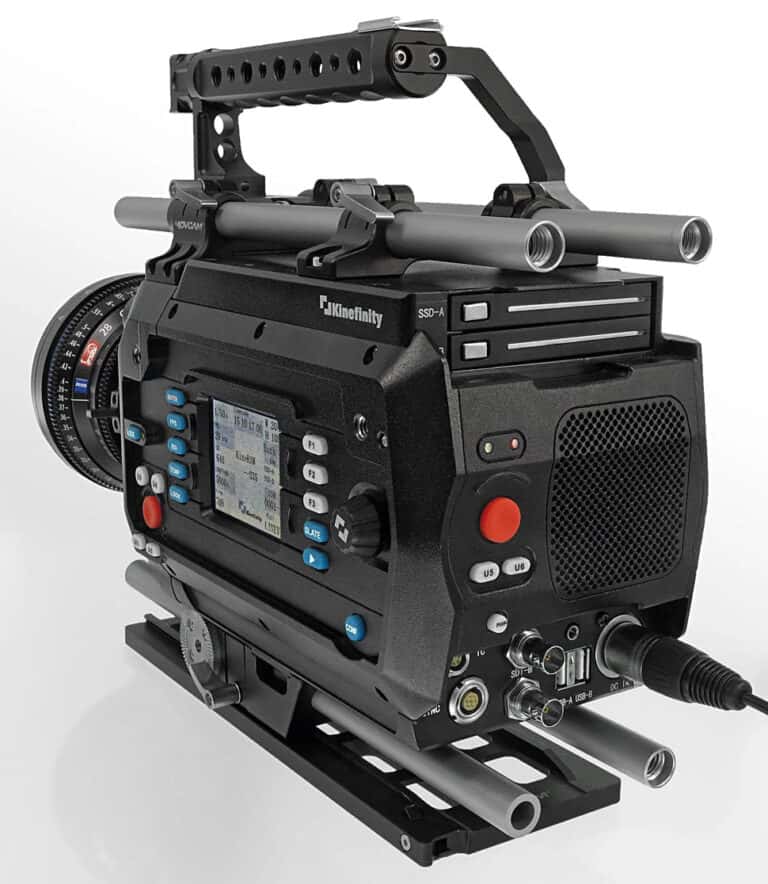
The KineRAW-S35 prototype shown in 2011 used a Super 35 CMOS sensor and could record 12-bit RAW as CinemaDNG or CineForm RAW to SSD. The production camera followed after Kinefinity's formal establishment in 2012. Even this first generation contained several ideas that would become recurring themes.
One was KineMOUNT. Rather than permanently committing the camera body to one lens family, Kinefinity used a short-flange camera-side interface that could be adapted to different lens systems. PL and photographic lenses could therefore belong to the same camera ecosystem. The principle would survive through TERRA, MAVO, Edge, MAVO mark2 and VISTA. Kinefinity now describes the original KineRAW-S35 as the first camera to use its native short-flange KineMOUNT.
The second idea was more conceptual. Kinefinity described the system as “RAW + LOOK.” The camera recorded the sensor information while simultaneously generating a 3D LUT corresponding to the appearance used for monitoring. KineLOG, KineColor and Kine709 could therefore be used to judge the image during shooting without making that monitoring image irreversible. The LUT could travel with the material and be recreated or replaced in post-production.
This was an unusually cinema-oriented idea for an inexpensive camera in 2012. The camera image was not considered finished merely because it appeared on a monitor. Acquisition and interpretation were deliberately kept separate. KineRAW-S35 also allowed variable frame rates and a Super 16 crop mode. Instead of treating the sensor as one fixed raster, the camera could use different portions of it for different optical formats and lenses.
The KineRAW-MINI took these concepts into a considerably smaller body. It retained the Super 35 RAW workflow but established another recurring Kinefinity ambition: make a genuine cinema camera small enough for an individual operator.
2014–2015: KineMINI 4K, KineMAX 6K and KineRAW as a codec
In 2014 Kinefinity introduced the KineMINI 4K and KineMAX 6K. KineMINI moved the compact camera concept to 4K acquisition, while KineMAX pushed the system to a 6K Super 35 sensor. There is an important historical distinction here. KineRAW had originally been the name of the camera system and its RAW-oriented philosophy. The proprietary .krw recording format came later.
KineOS 3.1, released for KineMINI in September 2014, introduced KineRAW as a lossless compressed RAW codec. Kinefinity described an average compression ratio of approximately 3:1, reducing the enormous storage requirements of uncompressed RAW while retaining the original image information. KineMAX continued to develop another characteristic of the system: the recording format could correspond to an optical format rather than merely a delivery resolution.
It supported, among other choices, a native 2.39:1 mode and a 4K 4:3 anamorphic format. The monitoring system could desqueeze an anamorphic image for viewing and playback. Shutter remained expressed as a cinematographic angle, rather than only as a video-style fraction of a second. This distinction matters.
A cinematographer does not necessarily start by asking, “Do I want 4K or 6K?” The more useful questions may be: Which part of the sensor do I want? What image circle does the lens cover? Is the lens spherical or anamorphic? Which aspect ratio am I composing for? What frame rate do I require? How should that image be monitored?
Kinefinity increasingly built those questions directly into the camera.
A film-camera logic inside a digital menu
This became one of the more distinctive aspects of Kinefinity's design. UHD, DCI 4K and HD describe an output raster. They do not, by themselves, describe the physical area photographed by the lens. Kinefinity made that distinction increasingly explicit in its recording menus.
The sensor itself is an imaging area from which different gates can be selected. A recording mode can therefore describe not only the number of recorded pixels but also:
- the physical sensor area being used;
- the resulting image-circle requirement;
- the aspect ratio of that area;
- whether the image is oversampled or cropped;
- its maximum frame rate;
- its relationship to spherical or anamorphic lenses.
This is much closer to choosing between 35mm, Super 35, Academy, Scope or an anamorphic gate than to changing the resolution of a conventional video camera. The camera menus consequently contain a large number of formats, but the variety is not arbitrary. It exists because different lenses and compositions make different demands on the sensor.
This philosophy becomes increasingly visible from TERRA onward.
2016–2017: TERRA, a cinema camera reduced to its core
Kinefinity announced TERRA in 2016 as an extremely compact Super 35 camera platform. Initial plans included 5K and 6K versions; the 6K model reached production first. The TERRA 6K body weighed approximately one kilogram. Instead of building every professional connector into the core camera, Kinefinity separated the recording engine from much of the surrounding production infrastructure.
The optional KineBACK added SDI outputs, XLR audio with phantom power, V-mount battery support, regulated power outputs and synchronisation connections. The same small camera could therefore be stripped down for lightweight operation or built into a more conventional cinema rig. This modularity was not merely cosmetic. It meant that specifications had to be read as a camera configuration rather than as a list belonging automatically to the body. An SDI connection provided by KineBACK was not an SDI output on the bare TERRA.
TERRA also marked a major change in recording workflow. Kinefinity added internal Apple ProRes, alongside 12-bit KineRAW. ProRes support was also announced for the existing KineMAX and KineMINI through firmware. For many productions, a Kinefinity camera no longer required a RAW-centric post-production workflow. It could record an established editing and grading codec internally.
At the same time, the cinema-format philosophy became more explicit. TERRA 6K offered 4:3 anamorphic recording, while TERRA 4K later gained both Open Gate and 4:3 anamorphic modes through KineOS 6.0. In Open Gate the camera used the available sensor area rather than automatically cutting it into a conventional television-shaped image.
KineOS 6.0 also redesigned the interface. Kinefinity explicitly described its layout as being organised according to the operating habits of cinematographers and camera assistants. Key parameters, codec, clip information and timecode were brought together around that workflow. Kinefinity cameras expose many parameters because cinematography itself contains many interdependent variables. The goal is not to hide those choices but to make them accessible.
2018–2019: MAVO, Open Gate and large-format cinematography
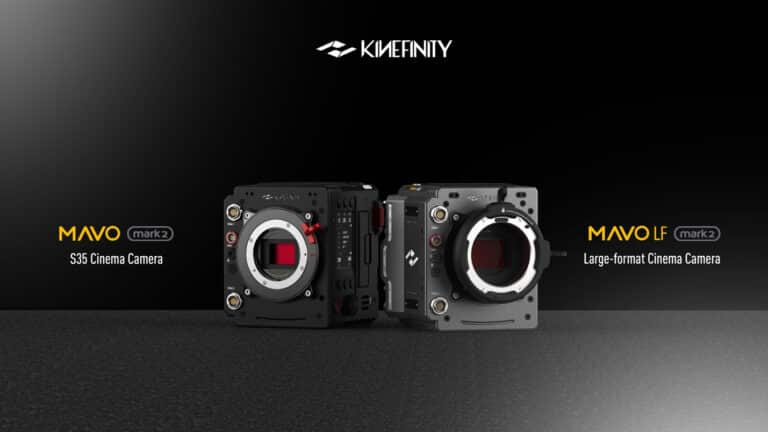
The MAVO and MAVO LF arrived in 2018. MAVO retained a Super 35 format. MAVO LF introduced a 36 × 24mm full-frame sensor and dual native ISO 800/5120, bringing Kinefinity into the emerging large-format cinema-camera market. But sensor size was only one part of the change.
MAVO dramatically expanded the relationship between sensor and recording window. The cameras offered Open Gate, wide formats, conventional cinema ratios and dedicated anamorphic areas. MAVO's 6K Open Gate mode used essentially the complete sensor. Dedicated 4:3 and 6:5 modes gave 2× anamorphic lenses a tall capture area. Smaller M4/3, Super 16 and other crop areas could be used for lenses that could not cover the complete sensor.
MAVO LF extended the same idea to full frame. Its recording table included full-frame 3:2 Open Gate, 4:3, 6:5, 17:9 and 2.4:1 options, alongside smaller Super 35 sensor windows. The physical meaning of the recording mode therefore became extremely important. A PL lens fitting mechanically onto a full-frame camera does not mean it covers a 36 × 24mm image. A Super 35 anamorphic lens might work beautifully in a smaller 4:3 window while vignetting badly in full-frame Open Gate.
The camera lets the cinematographer choose which part of the sensor belongs to the lens. That is classical cinema thinking in digital form. Our MAVO S35 mark2 article continues this approach: full frame, Super 35 and smaller sensor windows are not a simple hierarchy of image quality. They are optical formats that belong to particular lenses, framing requirements and productions.

Open Gate: 3:2 cinematography and 4:3 framing
Open Gate became especially important in the MAVO generation and remains central to current Kinefinity cameras. The principle comes directly from film. Instead of masking or cropping the image to the intended projection ratio during acquisition, Open Gate records a larger portion of the available imaging area. The cinematographer or post-production team can determine the final extraction later.
Digitally this creates several possibilities. 3:2 Open Gate can be the intended cinema aspect ratio itself: 1.5:1, using the height of the sensor as part of the composition. It does not have to be treated as spare pixels around a wider finish. For a 4:3 composition, monitor with 4:3 frame guides or blanking while recording the full 3:2 Open Gate image. The areas outside the 4:3 frame remain in the file, leaving room for horizontal reframing in post without changing the chosen framing on set. Other extractions, stabilisation and tall anamorphic acquisition can use that recorded area differently.
The value of Open Gate therefore is not simply that the file contains more pixels. It preserves options around composition and optics. That philosophy is particularly visible in Kinefinity because Open Gate exists alongside many smaller deliberately chosen sensor windows rather than replacing them.
Anamorphic as a native camera format
The same distinction applies to anamorphic cinematography. Simply attaching an anamorphic lens is only part of the problem. The camera must decide which area of the sensor is being photographed and the operator must be able to see a correctly proportioned image while shooting. Kinefinity progressively integrated both sides of that problem.
TERRA and MAVO offered dedicated tall 4:3 and 6:5 recording areas. Later Edge firmware expanded the available combinations further across full-frame and Super 35 sensor areas, including 3:2, 4:3, 6:5 and even 1:1 modes on certain cameras. Desqueeze belongs to the monitoring path rather than necessarily to the recording itself. The squeezed sensor image can remain intact while the operator sees the intended composition.
Kinefinity has continued to broaden that system. Its EAGLE viewfinders support a range of anamorphic monitoring ratios including 1.25x, 1.33x, 1.5x, 1.75x, 1.8x and 2x, as well as reciprocal 0.5x and 0.67x values. VISTA firmware 10.1 goes further by writing anamorphic information into MOV metadata and supporting both horizontal and vertical anamorphic formats. Compatible software such as QuickTime and DaVinci Resolve can read that metadata and automatically display the intended aspect ratio.
The point is not that everybody needs nineteen recording formats or a vertically squeezed anamorphic lens. The point is that the camera does not assume everybody photographs the world through the same rectangle.
KineMOUNT: continuity without locking the camera to one lens family
Through all these sensor changes, KineMOUNT remained one of the strongest links between Kinefinity generations. Its basic idea is simple. The camera-side KineMOUNT interface has a short flange distance. A separate adapter establishes the mount and flange distance required by the lens.
PL, EF, LPL and other systems can therefore be treated as interchangeable optical interfaces rather than as permanent identities of the camera body. Changing a KineMOUNT adapter uses the locking interface without removing the camera-side mount assembly. The adapter still has to maintain the correct flange distance for the lens; it does not eliminate the need for accurate lens and mount calibration.
This should not be confused with replacing the complete camera-side mount. On cameras supporting Active E or Active PL, those assemblies attach directly to the body and are a different layer of the system. The current VISTA lens mount guide explains the distinction between KineMOUNT, Active E and Active PL in detail.
2020–2022: MAVO Edge integrates the cinema rig
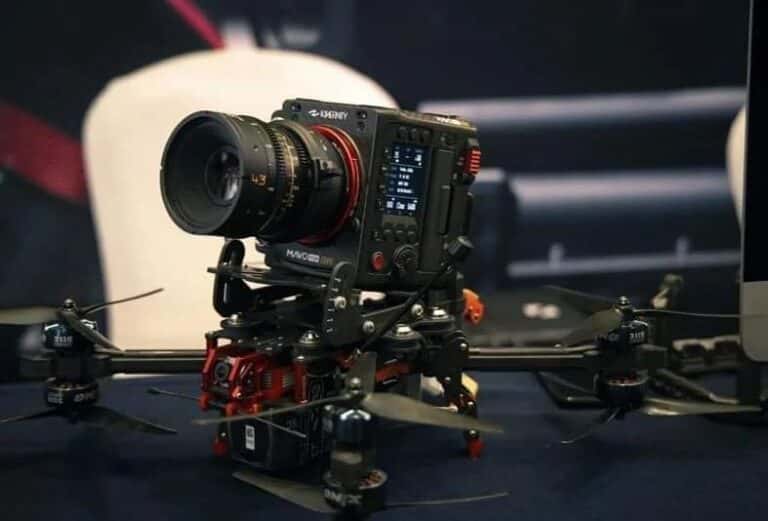
Kinefinity announced the MAVO Edge 8K on 27 April 2020. Edge was important because it changed the architecture of the camera more profoundly than the jump to 8K suggests. TERRA and the original MAVO derived much of their flexibility from adding modules around a compact core. Edge brought far more of the production camera into the body itself.
The carbon-fibre camera integrated an electronic ND system, professional monitoring connections, audio, timecode and accessory power, while moving recording from SATA SSD media to high-bandwidth NVMe-based KineMAG Nano storage. It also returned to two recording-media positions, echoing the dual-slot architecture of the original KineRAW-S35. The result was less dependent on rear modules and external infrastructure.
A distinction in the recording history is worth preserving. The original 2020 Edge announcement described support for 8K ProRes RAW. The eventual production workflow centred on ProRes, and RAW would later return to the Edge generation in a different form through KineOS 8. The MAVO Edge 6K subsequently combined the Edge architecture with a full-frame 6K sensor.
Kinefinity's two camera philosophies were becoming visible: the very compact modular camera and the integrated production camera. Edge represented the second.
Edge also expanded the digital gate
Edge continued the optical-format philosophy rather than simplifying it. Firmware additions introduced more 3:2 Open Gate and anamorphic recording areas, with combinations including full-frame 4:3 and 6:5, Super 35 4:3 and 6:5, and on Edge 6K even a 1:1 sensor window. The resolution label is therefore only part of the recording format.
But “5K” or “4K” is only one coordinate. A mode such as 5K 4:3 describes a very different piece of the lens's projected image from 5K 2.4:1. Even when their horizontal resolution is similar, they are different optical gates. This is why Kinefinity's modern specification tables increasingly list the physical dimensions of the active sensor area.
For cinematography, millimetres can be more informative than pixels.
2023: MAVO mark2 and three approaches to the lens mount
The MAVO mark2 S35 and MAVO mark2 LF continued the Edge-era processing architecture while returning to two familiar cinematographic formats: Super 35 and full frame. MAVO mark2 LF inherited the full-frame 6K sensor associated with Edge 6K, while MAVO mark2 S35 used a high-speed 6K Super 35 sensor.
The more important development for the wider Kinefinity system was at the front of the camera. Kinefinity retained native KineMOUNT, but added complete Active E and Active PL camera-side mounts. Active E brought electronic communication with compatible modern E-mount lenses. Active PL provided a direct cinema-style PL interface with Cooke /i metadata support. KineMOUNT remained the adaptable option for rapidly moving between separate PL, EF, LPL and other adapters.
Instead of forcing every cinematographer into one definition of a cinema lens, the same camera platform could now begin from three different mount philosophies.
The recording workflow: from RAW to ProRes and back to RAW
Kinefinity's codec history mirrors the development of the cameras themselves. The original KineRAW cameras were fundamentally RAW acquisition systems. CinemaDNG and CineForm preserved a large degree of sensor information for interpretation in post. The proprietary compressed KineRAW .krw codec arrived in 2014 as an attempt to make that RAW workflow more practical.
ProRes then became increasingly important from the TERRA generation onward. Instead of requiring a RAW development stage, the camera could produce robust files that could move directly into editing and grading. This did not eliminate Kinefinity's original separation between acquisition and appearance. Log recording and LUT-based monitoring continued the same philosophical distinction in a more convenient production format.
Kinefinity's official LUT collection shows that colour processing itself changed between generations. Early KineRAW-S35 and KineRAW-MINI material used KineLOG2-related transforms, while later KineMINI, KineMAX, TERRA, MAVO and Edge workflows moved into KineLOG3. In 2024, KineOS 8 introduced internal uncompressed DNG RAW up to 4K to MAVO Edge 8K, Edge 6K and MAVO mark2 cameras, alongside their ProRes recording. This is a 4K RAW workflow, not native 6K or 8K RAW acquisition; available image areas and frame rates depend on the model and recording mode.
This was not simply the resurrection of the old .krw codec. It was another generation of RAW workflow. That distinction matters for colour management. A LUT, Log transform or RAW decoder should always be associated with the actual camera, colour encoding and firmware generation involved.
Our MAVO Edge and MAVO mark2 firmware guide collects the current firmware information without assuming that a function introduced on one generation applies to every Kinefinity camera.
The menu is part of the camera design
An easily overlooked part of this history is KineOS itself. As the cameras gained more optical formats and monitoring functions, the interface had to expose increasingly complex relationships without turning the camera into a computer terminal. KineOS 6 reorganised important parameters around the working methods of cinematographers and assistants. KineOS 7 later introduced a touchscreen-oriented interface with direct multi-parameter control and a redesigned menu hierarchy.
The core shooting decisions remain recognisably cinematographic: FPS. Shutter. ISO or EI. White balance. ND. Optical format. Codec. LUT. Lens. These controls separate creative decisions where the hardware and recording mode allow it. Sensor window, readout speed, codec and maximum frame rate remain technically interdependent.
That independence is important. Changing frame rate does not automatically mean the cinematographer wants a different shutter convention. Changing the delivery resolution does not automatically mean a smaller sensor crop is desirable. Loading a monitoring LUT does not necessarily mean the recorded image should contain that look.
The camera lets those decisions remain separate until there is a reason to connect them.
2024–2025: EAGLE takes the viewing system outside Kinefinity
Kinefinity had previously built proprietary monitoring solutions around its own cameras, including KineEVF. With EAGLE SDI, launched in July 2024, the company did something different: it turned the viewfinder into an independent cinema product. EAGLE SDI uses standard SDI input and external power, allowing it to work with cameras beyond Kinefinity's own ecosystem.
The EAGLE HDMI followed in January 2025, extending that concept to smaller cameras and HDMI-based rigs. This fits the broader Kinefinity philosophy surprisingly well. Monitoring is treated as its own part of the cinematography chain. The recording format belongs to the camera. The optical image belongs to the lens and sensor. The viewing transform belongs to the monitoring system.
Those components can communicate without needing to become the same thing. Our EAGLE HDMI vs SDI guide explains the practical installation differences, while the EAGLE firmware guide covers software updates.
2026: VISTA makes the cinema camera small again
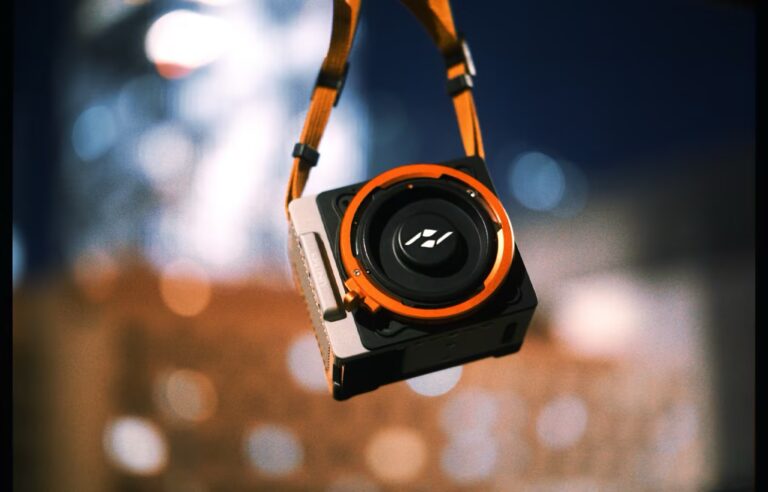
The VISTA, launched in June 2026, brings the story almost full circle. KineRAW-MINI and TERRA had both asked how much of a cinema camera could be reduced into a body intended for a small crew or individual cinematographer. VISTA asks the same question with fourteen more years of camera development behind it.
The camera uses a 36 × 24mm full-frame sensor with 6016 × 3984 3:2 Open Gate recording. In its KineMOUNT configuration the body weighs approximately 610 grams. A 4-inch 6:5 OLED touchscreen is built directly into the body, together with a 220GB internal SSD and a CFexpress Type B slot.
The shape of the display is itself revealing. A conventional 16:9 screen is awkward for a 3:2 Open Gate sensor because interface information competes with the image. VISTA instead uses a taller 6:5 display, allowing the complete 3:2 image to remain visible with space around it for camera information.
Even the screen has been designed around the gate.
Optical formats in a 610g camera
VISTA may be the clearest expression so far of Kinefinity's optical-format philosophy. VISTA combines full-frame and Super 35 anamorphic options with Micro Four Thirds-sized and Super 16-sized crops. The recording table distinguishes the physical image area from the encoded resolution. Full-frame modes include 3:2 Open Gate, 17:9, 2.4:1, 4:3 and 6:5 configurations. Super 35 adds further 6:5, 4:3, 3:2, DCI and Scope-style windows. Smaller areas permit higher frame rates or the use of lenses with smaller image circles.
Importantly, Kinefinity publishes each recording mode together with its physical optical format. For example, VISTA's full 6K Open Gate area is 36 × 24mm with a 43.3mm diagonal, while cropped 4K DCI uses approximately 24.5 × 12.9mm. Both may eventually produce a 4K deliverable.
They use different portions of the lens projection and register different fields of view. This is why reducing a cinema camera specification to “6K full frame” misses much of what the camera actually does. Our VISTA recording guide explains these sensor windows, frame rates and recording modes in practical terms.
VISTA is not a miniature Edge
Although VISTA inherits much of the philosophy developed through MAVO and Edge, it represents a different production model. Edge integrates the infrastructure of a conventional cinema rig. It has professional I/O, internal electronic ND and high-bandwidth recording options built around a larger production body. VISTA removes much of that infrastructure.
It has no internal electronic ND and no SDI system. Instead it provides two full-size HDMI outputs, internal OLED monitoring and a very low-power compact body. Its internal recording centres on 10-bit ProRes 422-family formats and H.265 rather than Edge's higher-bandwidth ProRes 4444/XQ and optional DNG RAW workflow.
It is a different answer to the question of what must live inside a cinema camera. For a gimbal, small handheld package, documentary camera or personal film, reducing the infrastructure can be as valuable as adding it.
VISTA continues the mount philosophy
VISTA is available around the same three mount concepts introduced in the modern Kinefinity system: KineMOUNT, Active E and Active PL. KineMOUNT is the adaptable route. Separate PL, EF, LPL and other adapters can be attached according to the lens package.
Active E provides a direct E-mount interface and electronic communication with supported lenses. Active PL creates a direct cinema-style PL interface. All three lead to the same sensor.
They are three different ways of deciding what should exist between the glass and that sensor. The VISTA lens mount guide covers those choices in detail.
What actually defines a Kinefinity camera?
Viewed chronologically, Kinefinity can appear to be a sequence of increasingly capable cameras:
KineRAW, KineMINI, KineMAX, TERRA, MAVO, Edge, MAVO mark2 and VISTA.
But that is not the most useful way to understand the company. The more interesting history is the development of a camera system organised around cinematography. The original KineRAW separated the recorded negative from the viewing look.
KineMOUNT separated the camera body from a permanent commitment to one lens mount. Crop modes separated the physical sensor from the assumption that its complete area always had to be used. TERRA separated the camera engine from the larger cinema rig.
MAVO made Open Gate, anamorphic gates and large-format sensor windows central to the camera. Edge brought the infrastructure of the production rig back inside the body. MAVO mark2 expanded the lens interface into KineMOUNT, Active E and Active PL.
EAGLE separated the viewfinder from a proprietary camera connection. VISTA combines a full-frame Open Gate sensor, many optical formats, built-in monitoring and internal recording in a body scarcely larger than some photographic cameras. The implementation keeps changing.
The underlying questions remain remarkably consistent.
The history of Kinefinity in gates, lenses and stops
This is perhaps the most useful way to understand Kinefinity. The cameras contain a great many resolutions, aspect ratios and menu options, but they are not there merely to produce a longer specification sheet. They represent cinematographic decisions.
Open Gate determines how much of the sensor becomes the negative. A 4:3 or 6:5 window determines how an anamorphic lens uses the sensor height. A Super 35 crop can make a full-frame camera compatible with a completely different lens family.
A 2.4:1 sensor window can reduce unnecessary data when the composition has already been decided. A monitoring desqueeze changes what the operator sees without needing to change what the sensor records. A LUT can determine the appearance on set while the underlying Log or RAW image remains available for another interpretation.
Shutter angle keeps motion rendering connected to frame rate in the language cinematographers have used for generations. They are the digital descendants of film gauge, gate, shutter, lens, ground glass, stock and laboratory. That is the thread connecting a bulky KineRAW-S35 prototype at BIRTV in 2011 to a 610-gram VISTA in 2026.
Kinefinity did not simply spend fourteen years adding resolution. It spent fourteen years trying to make the digital cinema camera behave more like a camera built for cinematographers. Kinefinity never completely abandoned the logic of the film camera. It digitised it.
Explore our current Kinefinity range or talk to Gafpa Gear about your camera setup.
Build your Kinefinity camera system
For KineMOUNT configurations, explore the electronic EF adapter, LPL adapter and PL e-ND and Clear Combo. The separate PL e-ND adapter offers 2–7 stops; the Clear adapter provides the alternative without ND attenuation. Our VISTA mount guide explains how adapter changes differ from replacing the complete camera-side mount.
Continue with our VISTA firmware guide, black balancing guide and sensor FPS versus project FPS article.
Original releases and technical documentation
KineRAW-S35 at BIRTV 2011 · RAW + LOOK · KineOS 3.1 · MAVO Edge announcement · KineOS 8 recording formats · VISTA optical formats.